Understanding developmental milestones for ages 3 to 5 shows rapid growth across language, social, motor, and cognitive domains. You’ll see vocabulary expand, sentence complexity rise, and clearer speech, along with emerging storytelling and functional communication in daily activities. Socially, children form simple friendships, share, and practice turn-taking with guidance. Fine and gross motor skills advance toward writing readiness and coordinated movement; problem-solving and imaginative play sharpen versatility. Expect gradual independence in self-care and routines, with gradual milestones guiding next steps. If you continue, you’ll learn more.
Language Milestones for Ages 3–5

Between ages 3 and 5, most children rapidly expand vocabulary and sentence complexity, using more descriptive and complex grammar, whereas improving intelligibility and conversational skills. You’ll observe growing sentence length, use of conjunctions, and clearer pronouns, alongside improved phonology that supports intelligibility. Language development becomes more intentional, with children labeling emotions, describing events, and asking diverse questions. You notice topic maintenance in conversations and better turn-taking cues, signaling burgeoning social communication alongside linguistic growth. Speech should remain intelligible to unfamiliar listeners, with rare misunderstandings addressed through repetition and pacing. When assessing progress, emphasize functional communication across contexts—home, preschool, and peer interactions. Early milestones reflect the integration of form, content, and social use, reinforcing a sense of belonging within your child’s learning community.
Social Skills: Making Friends and Sharing
You begin to notice that children around ages 3 to 5 start forming simple friendships and seek peer interaction as a normal developmental step. You’ll assess how they initiate play, respond to shared activities, and begin to understand sharing and turn-taking as foundational social skills. You’ll frame discussions around Making Friends Skills and Sharing and Turn-Taking to guide observation and support.
Making Friends Skills
In preschoolers, making friends hinges on developing joint attention, turn-taking, and basic sharing behaviors, which together support smoother peer interactions. You’ll observe that friendship dynamics emerge as you model gentle initiation, responsive listening, and affectionate affect. Your aim is to scaffold confidence, clarify expectations, and provide predictable routines that nurture belonging. When challenges arise, you guide conflict resolution through calm framing, problem analysis, and collaborative solutions. This section emphasizes observable skills, not internal motivations, to support practical growth in social play.
| Skill cue | Desired outcome |
|---|---|
| Initiation cues | peers respond positively |
| Response to peers | sustained interaction |
This framework supports meaningful connections while avoiding coercive pressures and promoting autonomy.
Sharing and Turn-Taking
Sharing and turn-taking are foundational social skills in early childhood, enabling preschoolers to distribute resources, wait for cues, and cooperate during play. You’ll notice that effective sharing hinges on clear sharing boundaries and practical turn taking prompts, guiding behavior without stifling initiative. With consistent guidance, you’ll support smoother peer interactions and foster a sense of belonging.
- Observe signals: identify when a peer is ready to share and when to prompt a pause.
- Prompt options: use simple turn taking prompts to alternate roles and tools.
- Reinforce outcomes: acknowledge successful sharing moments to sustain confident participation.
Fine Motor Milestones: Writing Readiness and Self-Help Tasks
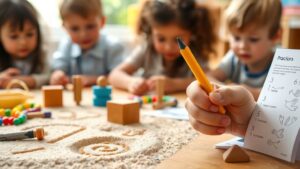
Fine motor development at ages 3 to 5 includes emerging writing readiness and practical self-help tasks, with proficiency hinging on coordinated finger control, hand strength, and visual-spatial awareness. You’ll notice kids progress from tripod grasp experimentation to more stable pencil use as finger isolation improves. Fine motor planning supports purposeful drawing, scissor use, and letter-sound connections during writing tasks. Self help emerges through dressing, buttoning, and managing zippers; these skills rely on sustained attention, fine-motor precision, and tactile feedback. You benefit from consistent practice, deliberate routines, and accessible tools that match hand size and strength. Monitor frustration and provide short, achievable steps to reduce anxiety. By strengthening these domains, you foster independence, confidence, and belonging within daily activities and classroom tasks.
Gross Motor Milestones: Running, Jumping, and Coordination
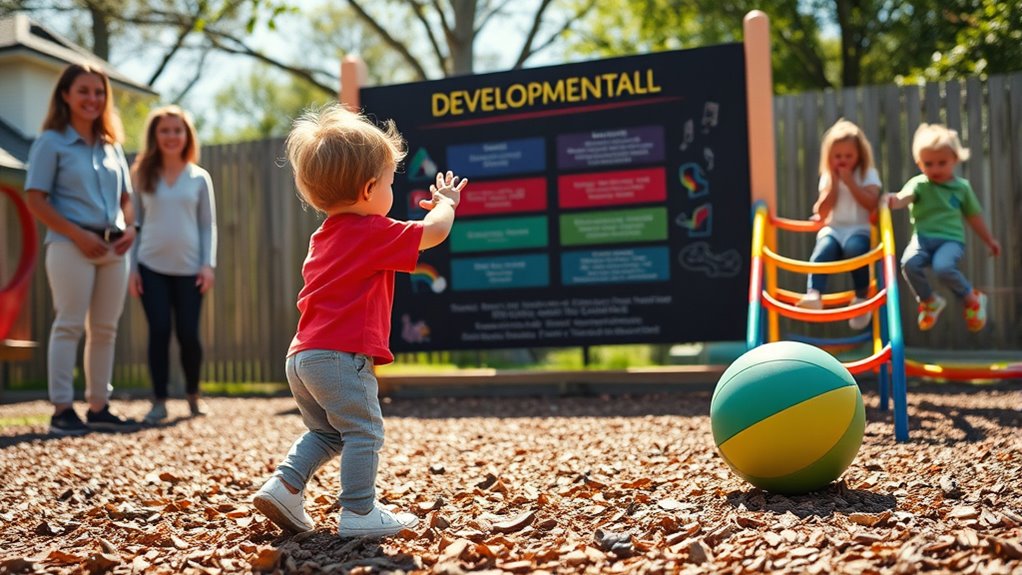
Gross motor milestones for ages 3 to 5 build on foundational play from fine motor tasks, highlighting improvements in running, jumping, and coordinated movement. You’ll notice better balance progression as you practice transitions between steps, hops, and quick directional changes. This phase marks refined scapular and core control, enabling longer strides and steadier landings. Your child’s confidence grows through purposeful practice, embracing safe risk within structured environments. The following observations summarize typical progress:
- Running shows increased speed, control, and braking ability on varied surfaces.
- Jumping becomes more two-footed, with improved height, distance, and land–softness.
- Coordination advances across ball games, stairs, and obstacle courses, reinforcing rhythm and bilateral integration.
Cognitive Growth in Preschool: Thinking, Solving Problems, and Imagination
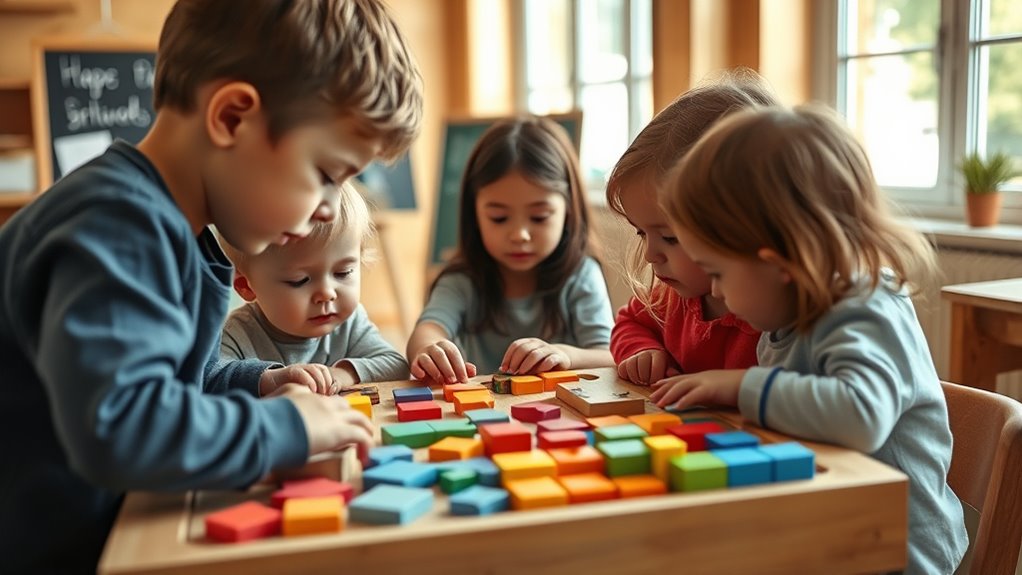
You’re observing how preschoolers tackle problems, from simple puzzles to everyday decisions, and you’ll see problem-solving skills emerge as they test hypotheses and adjust strategies. Imagination and play fuel cognitive growth by letting them simulate scenarios, experiment with roles, and expand symbolic thinking. Cognitive flexibility grows as they maneuver attention, adapt rules, and consider multiple viewpoints during play and learning tasks.
Problem-Solving Skills
Problem-solving skills in preschool emerge through repeated, guided exploration of familiar tasks, where children test hypotheses, adjust approaches, and learn from outcomes. You observe how this foundational thinking underpins daily challenges, from puzzles to simple conflict resolution, while you notice language milestones guiding verbal reasoning and shared planning.
- You model strategies, inviting purposeful trial, error, and reflection to strengthen cognitive flexibility.
- You support task decomposition, helping you articulate steps, compare results, and refine methods.
- You celebrate progress with precise feedback, reinforcing self-regulation and collaborative problem solving.
In this phase, your child’s brain links thinking with language, enabling more deliberate choices, sequence awareness, and confident engagement. This focused growth supports ongoing cognitive development and social belonging.
Imagination and Play
How does imaginative play fuel cognitive growth in preschoolers? In this stage, you’ll see imaginative play shaping thought processes, problem representation, and memory structuring through pretend scenarios. Your child uses roles, objects, and scenarios to experiment, test hypotheses, and predict outcomes, guiding early executive skills with social context. Imaginative play supports shared attention, symbolic reasoning, and narrative sequencing, fostering cognitive resilience and confidence. You’ll notice clearer goal setting, sequential planning, and self-regulation as play rules and timelines emerge. This is your invitation to provide safe spaces, supportive language, and time for open-ended exploration, nurturing belonging and autonomy. Embrace collaborative play that validates ideas and encourages exploration.
| Theme | Mechanism | Benefit |
|---|---|---|
| Imaginative play | Symbolic thinking | Cognitive scaffolding |
| Pretend scenarios | Social negotiation | Executive growth |
| Role-taking | Perspective shifts | Empathy and planning |
| Story sequencing | Narrative memory | Predictive reasoning |
Cognitive Flexibility Growth
Cognitive flexibility growth in preschoolers builds on the imaginative play described earlier by adding the ability to adjust strategies, adapt to new rules, and consider multiple perspectives. You’ll notice growing capacity to shift from one approach to another when goals change, a key marker of cognitive development. This skill supports problem solving, social interaction, and adaptive learning across settings.
- Observe how your child switches tasks and rules, noting smoother transitions when expectations shift.
- Encourage perspective-taking through collaborative play, where peers’ viewpoints influence decisions.
- Provide varied problem types that require flexible responses, reinforcing strategies without frustration.
This development fosters belonging, as your child learns to negotiate, cooperate, and meet challenges with adaptable thinking. Cognitive flexibility strengthens confidence in navigating everyday decisions.
Independence in Daily Routines: Self-Care and Responsibility
As children aged 3 to 5 begin to maneuver daily routines with growing competence, they increasingly demonstrate self-care skills and a sense of responsibility that support independent functioning. You’ll observe progress in independence routines and self care responsibility as tasks become more purposeful and predictable, boosting confidence and autonomy. Small, consistent expectations help structure behavior, while praise reinforces mastery without crowding effort. In practice, you support dressing, hygiene, snack preparation, and routine transitions with clear steps, brief prompts, and flexible timing. This promotes executive function and self-regulation, aligning with developmental goals. Table below illustrates key domains and targets for caregivers to monitor progress.
| Domain | Skill | Benchmark |
|---|---|---|
| Hygiene | Handwashing | Uses soap, 20 seconds |
| Dress | Managing fasteners | Independent zipping |
| Nutrition | Snack prep | Simple, safe choices |
| Transitions | Routines | Predictable sequencing |
Red Flags in Preschool Development: When to Seek Extra Support
W h i l e m a n y 3- to 5-year-olds show steady gains in self-care and daily routines, some children may display patterns suggesting the need for additional evaluation or support. You’ll want to watch for red flags that interfere with learning or social engagement, as early signs can guide timely help. Timely identification supports smoother development and fits your goal of belonging and progress.
- Persistent delays in language or inability to follow multi-step directions
- Limited imitation, play with peers, or difficulty sharing and taking turns
- Frequent tantrums, sensory distress, or withdrawal in typical settings
If these signs persist, seek guidance promptly from a pediatrician or developmental specialist to determine next steps and supports.
What to Expect Next: Quick Guide to Tracking Milestones
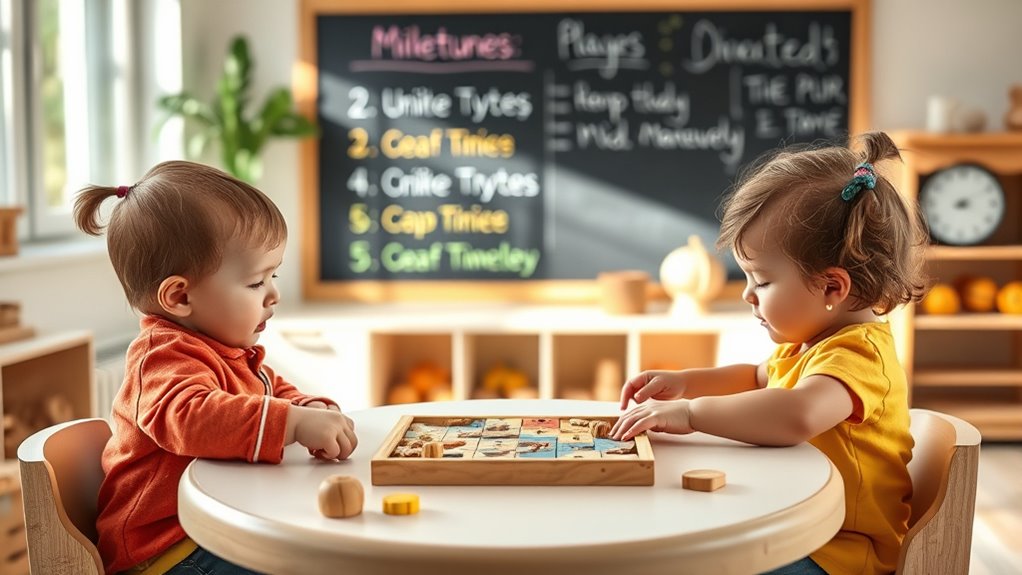
Tracking milestones for ages 3 to 5 is about what to expect next, not what to panic over, and it focuses on practical, observable progress you can monitor over weeks to months. You’ll track skill clusters rather than isolated tasks, noting consistency, breadth, and context. Use brief, regular observations during play, meals, and routines to build a trajectory. Prioritize core domains: language, social-emotional, motor, and self-care. If you notice steady gains with small plateaus, that’s typical. When gaps appear, consider targeted approaches like music therapy to support rhythm, listening, and positive engagement, or structured play to scaffold social scripts. Balance screen time with hands-on activities that encourage exploration, turn-taking, and problem-solving to reinforce healthy development and a sense of belonging.
Frequently Asked Questions
How Can Play Help With Learning at This Age?
Play helps you learn by building problem-solving and social skills; learning through play supports language, memory, and creativity. You’ll see cognitive growth, emotional regulation, and belonging as you participate with peers, adults, and guided play activities.
What Indicates Typical vs. Delayed Social Interaction?
Typical social involvement includes eye contact, shared attention, and responsive turn-taking; delayed social shows limited interest, fewer words, or unreciprocated interactions. You observe patterns over weeks, and seek评 professional guidance if concerns persist or regress.
When Should a Child Start Reading Aloud Progress?
Reading aloud milestones typically emerge around ages 4 to 5; you’ll notice early literacy signs like letter-sound awareness, matching spoken to print, and simple sentence reading. You progress with confidence, belonging, and steady, observable developmental steps.
Are There Activities to Boost Attention Span?
Yes. You can use attention exercises and focus tips to boost attention span, pairing short, structured tasks with prompts and visualization. You’ll see gradual progress as routines become predictable, supportive, and inviting for your child’s developmental trajectory.
How Often Should a Doctor Review Milestones?
You should have frequent milestones reviewed at every visit, with a chart review to track changes. You’ll find this approach clinically precise, developmentally focused, and welcoming, reinforcing belonging during the transition to changes in your child’s progress.